How to Compute GWA in College (Step-by-Step Guide for Filipino Students)
Every Filipino college student reaches that moment, grades are out, and you need to know exactly where you stand. Not an estimate. Not a guess. Your actual GWA.
The problem is most guides either give you a vague formula and stop there or bury the calculation inside a wall of general information you did not come here to read.
This guide does one thing only: teach you how to compute your GWA correctly, step by step, with real examples you can follow using your own grades right now.
If you want to skip the manual steps entirely, use our free GWA Calculator for an instant result.
The GWA Formula (And What Each Part Actually Means)
The official formula for computing General Weighted Average is:
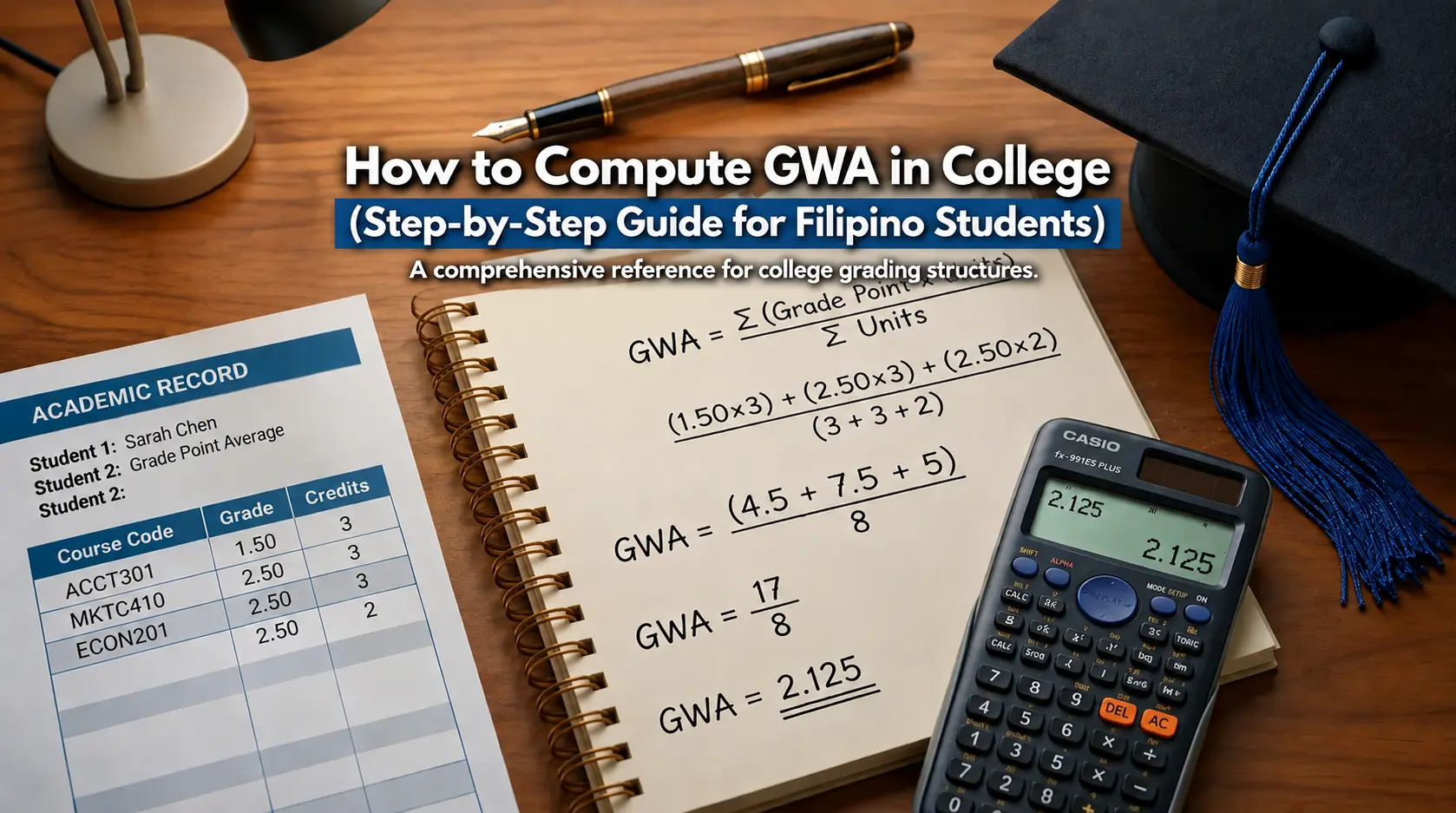
GWA = Sum of (Grade × Units) ÷ Total Number of Units
In mathematical notation:
GWA = Σ (Grade × Units) ÷ Σ Units
Where:
- Grade = the final grade you received in a subject
- Units = the number of credit units that subject carries
- Σ = “sum of” (add all values together)
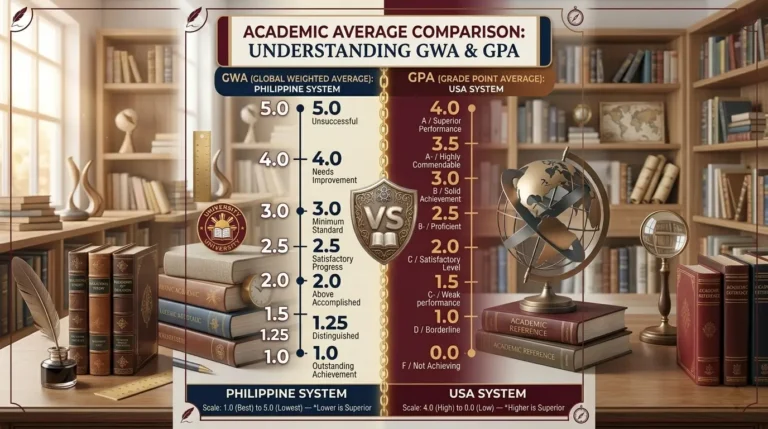
This formula is standard across most Philippine higher education institutions, though the grading scale used may vary per school.
Why You Cannot Just Average Your Grades
Suppose you scored 1.0 in a 1-unit PE class and 3.0 in a 5-unit Engineering Math subject. A simple average gives you:
(1.0 + 3.0) ÷ 2 = 2.0
But that is misleading. Engineering Math carries five times more academic load than PE. Your GWA should reflect that weight. The correct weighted calculation gives:
(1.0 × 1) + (3.0 × 5) = 1.0 + 15.0 = 16.0
16.0 ÷ 6 total units = 2.67
Your actual GWA is 2.67 significantly different from the simple average of 2.0. This is why the weighted formula exists, and why getting it right matters especially when you are near a scholarship cutoff or honors qualification.
The Two Numbers You Always Need
No matter how many subjects you have, you only need two things to compute GWA:
- The sum of (Grade × Units) for every subject
- The total number of units across all subjects
Everything else is just filling in those two numbers correctly.
Step-by-Step: How to Compute GWA in College
Let us walk through a complete computation from start to finish using a realistic one-semester subject load.
Step 1: Collect Your Grades and Units
Get your grade slip or check your university’s online portal. For each subject, you need two values: the final grade and the number of credit units.
Here is a sample semester for a second-year college student:
| Subject | Credit Units | Final Grade |
|---|---|---|
| Engineering Mathematics 2 | 5 | 2.25 |
| Physics for Engineers | 4 | 2 |
| Technical Communication | 3 | 1.5 |
| Computer Programming 1 | 3 | 1.75 |
| Engineering Drawing | 2 | 1.25 |
| Physical Education 2 | 1 | 1 |
| Total | 18 |
Step 2: Multiply Each Grade by Its Units
Take each row and multiply the grade by the units. Write the result in a new column.
| Subject | Credit Units | Final Grade | Grade × Units |
|---|---|---|---|
| Engineering Mathematics 2 | 5.00 | 2.25 | 11.25 |
| Physics for Engineers | 4.00 | 2.00 | 8.00 |
| Technical Communication | 3.00 | 1.50 | 4.50 |
| Computer Programming 1 | 3.00 | 1.75 | 5.25 |
| Engineering Drawing | 2.00 | 1.25 | 2.50 |
| Physical Education 2 | 1.00 | 1.00 | 1.00 |
| Total | 18.00 | 32.50 |
Step 3: Add All the Weighted Grades
Add up the entire “Grade × Units” column:
11.25 + 8.00 + 4.50 + 5.25 + 2.50 + 1.00 = 32.50
Step 4: Divide by Total Units
GWA = 32.50 ÷ 18 = 1.806
Round to two decimal places:
Semester GWA = 1.81
This student’s GWA for the semester is 1.81 which falls in the “Good” range on the standard Philippine 5-point grading scale and qualifies for most university scholarship programs.
Want to verify this result? Enter the same subjects into our GWA Calculator and confirm your answer in seconds.
How to Compute Cumulative GWA (Across Multiple Semesters)
Your cumulative GWA is your overall weighted average from the time you started college up to your most recent semester. This is the number your registrar uses for honors determination and scholarship evaluation — not just your latest semester GWA.
The good news: the formula is exactly the same. You just treat all semesters as one big subject list.
Method 1: Using Semester Totals (Faster)
If you already computed your GWA per semester, you could use the semester totals directly instead of listing every subject again.
Here is a student’s record across three semesters:
| Semester | Sum of (Grade × Units) | Total Units |
|---|---|---|
| 1st Semester, Year 1 | 28.75 | 19.00 |
| 2nd Semester, Year 1 | 31.50 | 20.00 |
| 1st Semester, Year 2 | 32.50 | 18.00 |
| Combined Total | 92.75 | 57.00 |
Cumulative GWA = 92.75 ÷ 57 = 1.627
Cumulative GWA after 3 semesters = 1.63
Notice that the cumulative GWA (1.63) is different from simply averaging the three semester GWAs. This is because semesters with more units carry more weight in the overall average the same logic as subjects within a single semester.
For a faster cumulative GWA computation, our online GWA Calculator handles multiple semesters automatically, no manual addition needed.
Method 2: Listing All Subjects Together (More Accurate)
For a completely precise cumulative GWA, list every subject from every semester in one table and apply the formula once. This method is preferred by most university registrars because it accounts for every unit you have ever taken.
Why Your Cumulative GWA Can Surprise You?
A common situation: a student has a strong 1.50 GWA in their first semester (17 units) but a weaker 2.25 GWA in their second semester (22 units). They expect their cumulative average to be somewhere around 1.87.
Let us check:
1st Semester: 1.50 × 17 = 25.50
2nd Semester: 2.25 × 22 = 49.50
Total weighted: 75.00 ÷ 39 total units = 1.923
Their cumulative GWA is 1.92 closer to 2.0 than they expected, because the second semester had more units and therefore pulled the average down more than they realized. This is exactly why tracking your cumulative GWA every semester matters. A single difficult semester with a heavy unit load can move your cumulative average more than you expect.
Run your own scenario using our GWA Calculator enter all your semesters and see exactly where your cumulative GWA stands right now.
How to Compute GWA When You Have Special Cases
Real academic records are rarely clean. Here is how to handle the situations that come up most often.
When You Have a Failed Subject (Grade of 5.0)
A failed grade is still included in your GWA computation. Do not skip it. Include it in the Grade × Units column just like any other subject.
Example: You failed a 4-unit subject with a grade of 5.0.
5.0 × 4 = 20.0
That 20.0 gets added to your weighted total just like any passing grade and it will significantly raise your GWA number (which on the Philippine 5-point scale means lowering your academic performance).
When You Have an INC (Incomplete) Grade
Do not include an INC grade in your computation. An Incomplete means no final grade has been recorded yet. Once you complete the requirements and receive a final grade, include that subject in your GWA from that point forward.
If your registrar computes GWA with INC subjects temporarily excluded, your computed GWA may change once the INC is resolved, keep this in mind when checking scholarship or honors eligibility.
When You Dropped a Subject (DRP)
Dropped subjects are excluded from GWA computation entirely. A DRP notation means you officially withdrew from the subject before the grading period — no grade, no units counted.
When PE or NSTP Has a Different Grading Format
Some universities grade PE and NSTP as Passed/Failed rather than a numerical grade. In that case, check your school’s policy most institutions exclude these from GWA computation when no numerical grade is assigned. When a numerical grade is given, include it normally.
The Fastest Way to Double-Check Your Manual Computation
After computing manually, verify your result using this quick check:
- Take your computed GWA and multiply it back by your total units
- The result should equal your total weighted grades (Sum of Grade × Units)
Using Step 4 example:
1.806 × 18 = 32.50 ✓
If the numbers match, your computation is correct. If they do not match, you made an arithmetic error somewhere in Step 2 or Step 3 go back and check each row individually.
The simplest double-check is to enter your grades into our free GWA Calculator and compare the result against your manual computation.
Frequently Asked Questions About Computing GWA-FAQs
Compute Your GWA Instantly
Now that you understand the formula and the steps behind it, you can compute your GWA manually with confidence any time you need to.
If you want to skip the manual work, use our free GWA Calculator enter your subjects, units, and grades and get your result instantly. It supports both the 5-point and 100-point grading scales and shows you the full computation breakdown so you can verify every step.