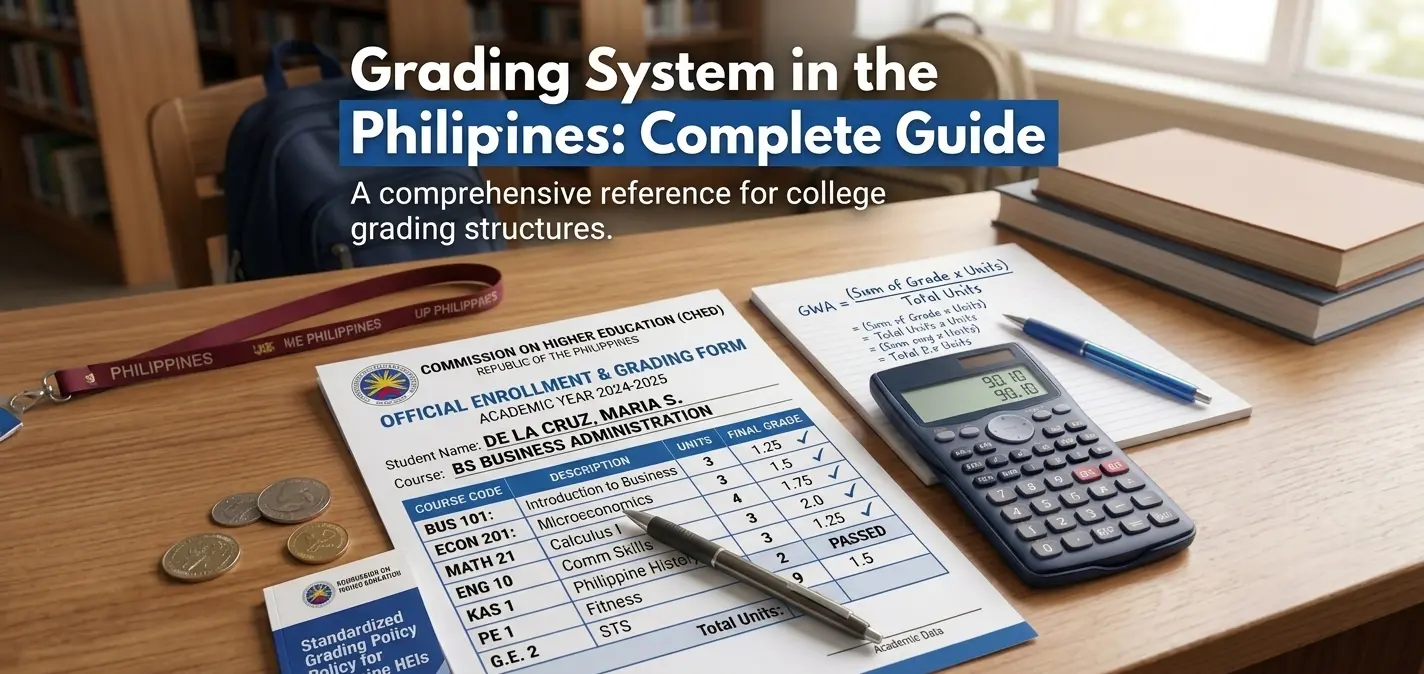
Grading System in the Philippines: Complete Guide (2026)
The grading system in the Philippines is not a single uniform standard, it is a structured framework that operates across multiple levels of education, each governed by different regulatory bodies, grading scales, and assessment criteria. From the Department of Education (DepEd) K–12 program in basic education to the Commission on Higher Education (CHED)-regulated tertiary institutions, understanding how academic grades are computed, interpreted, and applied is essential for every Filipino student, parent, and educator.
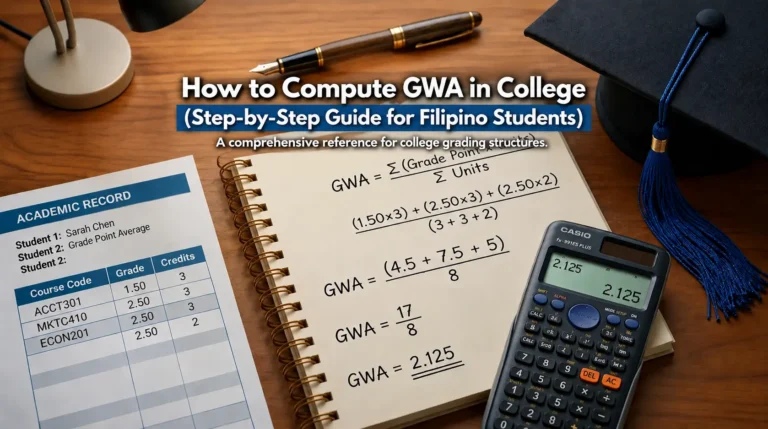
If you are a college student looking to compute your GWA right now, use our free GWA Calculator and get your result instantly.”
This comprehensive guide covers the grading system used across all education levels in the Philippines including elementary, junior high school, senior high school, college, and university along with university specific grading scales, passing grade requirements, Latin honors eligibility, and grade conversion to GPA and percentage formats.
Overview of the Philippine Grading System
The Philippine educational system is divided into three major levels, each with its own grading framework:
- Basic Education (Grades 1–12): governed by the Department of Education (DepEd) under the K–12 Basic Education Program
- Technical-Vocational Education: governed by TESDA (Technical Education and Skills Development Authority)
- Higher Education (College and University): governed by the Commission on Higher Education (CHED)
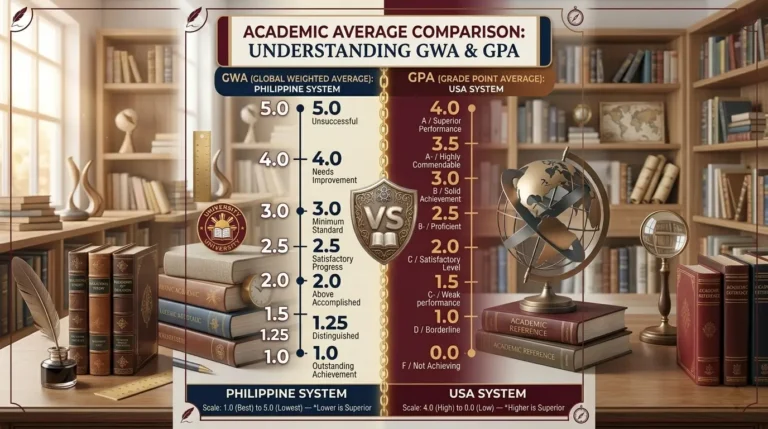
At the higher education level, Philippine colleges and universities use one of two primary grading scales: the 1.0–5.0 numerical scale (where 1.0 is the highest) or the 4.0 GPA scale (where 4.0 is the highest), which is modeled after the American grading system.
DepEd K–12 Grading System (Basic Education)
The Department of Education (DepEd) implements a standards-based and competency-based grading system for all public and private schools following the K–12 Basic Education Program, introduced through DepEd Order No. 8, s. 2015. This system evaluates student learning holistically through three core assessment components.
Three Components of the K–12 Grading System
Every learner from Grade 1 to Grade 12 is assessed each quarter based on the following summative assessment components:
| Assessment Component | Abbreviation | Weight (Languages) | Weight (Science/Math) | Weight (SHS Core) |
|---|---|---|---|---|
| Written Work | WW | 30% | 40% | 25% |
| Performance Tasks | PT | 50% | 40% | 50% |
| Quarterly Assessment | QA | 20% | 20% | 25% |
Written Work assesses student’s understanding of concepts and application of skills through quizzes, long tests, and written outputs. Performance Tasks require students to demonstrate and integrate knowledge through projects, group work, presentations, and hands-on activities. The Quarterly Assessment is a comprehensive examination administered once at the end of each grading period.
DepEd Grading Scale and Grade Descriptors
Under the DepEd K–12 program, all grades are reported on a 0–100 numerical scale. The minimum passing grade is 60, which is transmuted to 75 on the official report card (SF9). The lowest grade that can appear on any report card is 60 for both Quarterly Grades and Final Grades.
| Grading Scale | Grade Descriptor | Remarks |
|---|---|---|
| 90 – 100 | Outstanding (O) | Passed |
| 85 – 89 | Very Satisfactory (VS) | Passed |
| 80 – 84 | Satisfactory (S) | Passed |
| 75 – 79 | Fairly Satisfactory (FS) | Passed |
| Below 75 | Did Not Meet Expectations (DNM) | Failed |
To be promoted to the next grade level, a learner must earn a final grade of at least 75 in all subject areas. Students who fail to meet expectations in one or more subjects may enroll in remedial classes. Their recomputed final grade after remediation determines whether they are promoted or retained.
Kindergarten Assessment
Kindergarten learners are not assessed using numerical grades. Instead, DepEd uses checklists and anecdotal records based on developmental milestones outlined in the Kindergarten Curriculum Guide. Teachers compile portfolios of student output including writing samples, completed activity sheets, and artwork to track each child’s progress in literacy, numeracy, and social development.
How to Compute Grades Under the K–12 System
The grade computation process follows these steps each quarter:
- Step 1: Add all raw scores for each component (Written Work, Performance Tasks, Quarterly Assessment
- Step 2: Convert each component’s total raw score to a Percentage Score (PS) by dividing by the highest possible score and multiplying by 100.
- Step 3: Multiply each Percentage Score by its assigned weight to get the Weighted Score (WS).
- Step 4: Add all Weighted Scores together to get the Initial Grade.
- Step 5: Transmute the Initial Grade using the DepEd Transmutation Table to get the official Quarterly Grade (QG).
- Step 6: Average the four Quarterly Grades to compute the Final Grade for the school year.
College and University Grading System in the Philippines
At the tertiary level, the grading system in Philippine colleges and universities is not standardized across all institutions. The Commission on Higher Education (CHED) provides regulatory oversight, but individual Higher Education Institutions (HEIs) have academic freedom to adopt their own grading scales. Two dominant scales are used:
- The 1.0–5.0 Numerical Scale, the most common grading system in Philippine HEIs, where 1.0 represents the highest academic performance and 5.0 represents failure.
- The 4.0 GPA Scale, used by select institutions such as De La Salle University (DLSU) and FEU East Asia College, patterned after the American grading system where 4.0 is the highest grade.
Standard 1.0–5.0 Grading Scale (Most Common)
The following table reflects the most used grading equivalency in Philippine colleges and universities, excluding institutions that follow the 4.0 scale:
| GWA / Grade | Percentage Equivalent | Grade Description | US Grade Equivalent |
|---|---|---|---|
| 1.00 | 96–100% | Excellent | A+ |
| 1.25 | 94–95.99% | Superior | A |
| 1.50 | 91–93.99% | Very Good | A− |
| 1.75 | 89–90.99% | Good | B+ |
| 2.00 | 86–88.99% | Very Satisfactory | B |
| 2.25 | 83–85.99% | High Average | B− |
| 2.50 | 80–82.99% | Average | C+ |
| 2.75 | 77–79.99% | Fair | C |
| 3.00 | 75–76.99% | Passing | C− |
| 4.00 | 70–74.99% | Conditional | D |
| 5.00 | Below 70% | Failing | F |
Now that you know your grade equivalents, use our GWA Calculator to compute your exact General Weighted Average using this scale.
Special grade notations used across Philippine colleges and universities include:
| Notation | Meaning |
|---|---|
| INC | Incomplete — student did not complete required coursework |
| DRP | Dropped — student officially withdrew from the subject |
| W | Withdrawal — voluntary withdrawal from a course |
| WP | Withdrawal with Permission |
| WF | Withdrawal without Permission (may be treated as Failing) |
| NA | Never Appeared — student never attended the class |
| FDA | Failure Due to Absences |
| P | Passed — used in Pass/Fail grading systems |
University Specific Grading Systems in the Philippines
Because Philippine HEIs follow different grading policies, it is critical to understand the specific grading scale used by your institution. Below are the official grading systems of the country’s major universities.
University of the Philippines (UP) Grading System
The University of the Philippines system including UP Diliman, UP Manila, UP Los Baños (UPLB), UP Visayas, and UP Open University (UPOU), uses a numerical grading scale where smaller numbers represent higher academic achievement. The University of the Philippines is one of the most prestigious state universities in the Philippines, under the governance of the UP Board of Regents.
| Grade | Description | US Equivalent |
|---|---|---|
| 1.00 | Excellent | A |
| 1.25 | Excellent | A |
| 1.50 | Very Good | B+ |
| 1.75 | Very Good | B+ |
| 2.00 | Good | B |
| 2.25 | Good | B |
| 2.50 | Satisfactory | C+ |
| 2.75 | Satisfactory | C |
| 3.00 | Passing | C |
| 4.00 | Conditional Failure | D |
| 5.00 | Failure | F |
| INC | Incomplete | — |
| DRP | Dropped | — |
Polytechnic University of the Philippines (PUP) Grading System
The Polytechnic University of the Philippines (PUP), also known as “The Country’s 1st Polytechnic University,” uses the standard 1.0–5.0 numerical scale. The passing grade at PUP is 3.00, which is equivalent to 60–64.99%.
| GWA | Percentage Equivalent | Description |
|---|---|---|
| 1.00 | 92–100% | Excellent |
| 1.25 | 88–91.99% | Very Good |
| 1.50 | 84–87.99% | Good |
| 1.75 | 80–83.99% | Good |
| 2.00 | 76–79.99% | Satisfactory |
| 2.25 | 72–75.99% | Satisfactory |
| 2.50 | 68–71.99% | Fair |
| 2.75 | 64–67.99% | Fair / Passing |
| 3.00 | 60–63.99% | Passing |
| 5.00 | Below 60% | Failing |
University of Santo Tomas (UST) Grading System
The University of Santo Tomas, one of the oldest universities in Asia, uses the standard numerical 1.0–5.0 grading scale. The passing grade at UST is 3.00, equivalent to 75–79%.
| GWA | Percentage | Description |
|---|---|---|
| 1.00 | 96–100% | Excellent |
| 1.25–1.50 | 92–95.99% | Very Good |
| 1.75–2.25 | 84–91.99% | Good |
| 2.50–2.75 | 79–83.99% | Fair |
| 3.00 | 75–78.99% | Passing |
| 5.00 | Below 75% | Failing |
De La Salle University (DLSU) Grading System
De La Salle University uses the 4.0 GPA scale, making it one of the notable exceptions to the standard 1.0–5.0 system in the Philippines. At DLSU, 4.0 is the highest grade and 0.0 is a failing mark.
| DLSU Grade | Description | Percentage Range | US Grade |
|---|---|---|---|
| 4.00 | Excellent | 97–100% | A+ |
| 3.50 | Superior | 93–96% | A |
| 3.00 | Very Good | 89–92% | B+ |
| 2.50 | Good | 85–88% | B |
| 2.00 | Satisfactory | 80–84% | B− |
| 1.50 | Fair | 75–79% | C+ |
| 1.00 | Passed | 70–74% | C |
| 0.00 | Failed | Below 70% | F |
Ateneo de Manila University Grading System
Ateneo de Manila University, one of the Philippines’ premier private universities, uses a letter-based grading system. Students are evaluated based on subject specific criteria, and their final grades are expressed as letter grades corresponding to a 4.0 scale.
| Letter Grade | GPA Equivalent | Percentage Range | Description |
|---|---|---|---|
| A | 4.00 | 93–100% | Excellent |
| B+ | 3.50 | 87–92% | Very Good |
| B | 3.00 | 80–86% | Good |
| C+ | 2.50 | 73–79% | Satisfactory |
| C | 2.00 | 65–72% | Passing |
| D | 1.00 | 55–64% | Conditional |
| F | 0.00 | Below 55% | Failing |
Far Eastern University (FEU) Grading System
Far Eastern University and its affiliate FEU East Asia College follow the 4.0 GPA scale, like DLSU. Under this system, 4.0 represents the highest academic performance.
| Grade | Percentage Range | Description |
|---|---|---|
| 4.00 | 97–100% | Excellent |
| 3.50 | 93–96% | Superior |
| 3.00 | 89–92% | Very Good |
| 2.50 | 85–88% | Good |
| 2.00 | 80–84% | Satisfactory |
| 1.50 | 75–79% | Fair |
| 1.00 | 70–74% | Passed |
| 0.00 | Below 70% | Failed |
Mapúa University Grading System
Mapúa University, one of the leading engineering and technology universities in the Philippines, uses the standard 1.0–5.0 numerical scale for undergraduate programs.
| Grade | Percentage Range | Description |
|---|---|---|
| 1.00 | 97–100% | Excellent |
| 1.50 | 91–96% | Very Good |
| 2.00 | 85–90% | Good |
| 2.50 | 79–84% | Satisfactory |
| 3.00 | 73–78% | Passing |
| 4.00 | 67–72% | Conditional |
| 5.00 | Below 67% | Failing |
What is the Passing Grade in Philippine Colleges?
The minimum passing grade in most Philippine colleges and universities depends on the grading scale used by the institution. Understanding the passing threshold is critical for academic standing, course retention, and scholarship eligibility.
| Institution | Grading Scale | Passing Grade | Passing Equivalent |
|---|---|---|---|
| Most Philippine HEIs (standard) | 1.0–5.0 | 3.00 | 0.75 |
| University of the Philippines (UP) | 1.0–5.0 | 3.00 | 0.75 |
| Polytechnic University of the Philippines (PUP) | 1.0–5.0 | 3.00 | 60–64% |
| University of Santo Tomas (UST) | 1.0–5.0 | 3.00 | 0.75 |
| De La Salle University (DLSU) | 0.0–4.0 | 1.00 | 70–74% |
| Far Eastern University (FEU) | 0.0–4.0 | 1.00 | 70–74% |
| Tarlac State University (Engineering) | 1.0–5.0 | 3.00 | 60–64% |
At the secondary level (DepEd K–12), the passing grade is 75 in all subject areas. Students who fall below 75 in a subject do not meet expectations and may be required to attend remedial classes before being promoted to the next grade level.
Latin Honors in the Philippines: GWA Requirements
Latin Honors are academic distinctions awarded to graduating college students in the Philippines based on their cumulative General Weighted Average (GWA) throughout their entire degree program. These distinctions are rooted in medieval academic tradition and have been formally adopted by Philippine Higher Education Institutions under guidelines issued by the Commission on Higher Education (CHED).
There are three tiers of Latin Honors awarded at graduation in the Philippines:
| Honor | Latin Term | Standard GWA Range (CHED Guidelines) |
|---|---|---|
| With Highest Honors | Summa Cum Laude | 1.00–1.20 |
| With High Honors | Magna Cum Laude | 1.21–1.45 |
| With Honors | Cum Laude | 1.46–1.75 |
Important note: CHED guidelines serve as the baseline standard. Autonomous universities such as UP, UST, and DLSU may apply slightly different GWA thresholds. Always verify the exact Latin Honors criteria with your university’s registrar.
Latin Honors Requirements by University
| University | Summa Cum Laude | Magna Cum Laude | Cum Laude | Additional Conditions |
|---|---|---|---|---|
| University of the Philippines (UP) | 1.20 or better | 1.45 or better | 1.75 or better | No grade below 2.0; min. 15 units/semester |
| University of Santo Tomas (UST) | 1.00–1.20 | 1.21–1.45 | 1.46–1.75 | No failing grade; no disciplinary record |
| PUP / PLM (standard) | 1.00–1.20 | 1.21–1.45 | 1.46–1.75 | No grade of 5.0; residency requirement |
| DLSU (4.0 scale) | 3.80–4.00 | 3.60–3.79 | 3.40–3.59 | No failing grade; good standing |
Beyond the GWA threshold, most Philippine universities require that Latin Honors candidates meet all the following additional conditions:
- No failing grade (5.0 or equivalent) in any subject throughout the entire degree program
- No incomplete (INC) grade that was not resolved within the allowed period
- No disciplinary suspension or academic dishonesty record
- Completion of a minimum residency requirement (commonly 75% of total units must be taken at the degree-granting institution)
- A minimum academic load per semester (UP requires no fewer than 15 units per semester, unless justified by health or other approved reasons)
Academic Retention and Dismissal Policies
Philippine colleges and universities implement academic retention policies based on a student’s General Weighted Average (GWA) per semester. Failure to meet the minimum GWA requirement may result in academic warning, probationary status, or dismissal from the program or institution.
| Institution | Minimum GWA per Semester | Policy for non-compliance |
|---|---|---|
| Most Philippine Colleges (general) | 2.50 | Academic probation or program dismissal |
| Pamantasan ng Lungsod ng Maynila (PLM) | 2.50 | Academic warning → test status → dismissal |
| UP Diliman | 3.00 (per semester) | University Scholar, College Scholar thresholds apply |
| University of Santo Tomas (UST) | Varies by college | Academic probation with 2 semesters grace |
Beyond GWA requirements, most Philippine universities also have strict policies on:
- Maximum failed units per semester: Exceeding this threshold may trigger automatic dismissal
- Incomplete (INC) grades: Must be resolved within one semester or one academic year, or the grade converts to 5.0 (Failing)
- Class attendance: Most institutions impose automatic failure (FDA: Failure Due to Absences) when a student exceeds the allowable number of absences, typically 20% of class meetings
Philippine Grading System vs Global Grading Systems
For Filipino students pursuing international graduate studies, foreign scholarship applications, or overseas employment with academic requirements, understanding how Philippine grades compare to international standards is essential.
| Country/System | Scale | Highest Grade | Passing Grade | Notes |
|---|---|---|---|---|
| Philippines (standard HEI) | 1.0–5.0 | 1.00 | 3.00 | Lower number = better grade |
| Philippines (DLSU/FEU) | 0.0–4.0 | 4.00 | 1.00 | Follows US GPA model |
| Philippines (DepEd K–12) | 0–100 | 100.00 | 75.00 | Percentage-based |
| United States | 0.0–4.0 GPA | 4.00 | 2.00 (C) | Letter grades with GPA points |
| United Kingdom | 0–100 | 100+ | Varies | First Class, Upper/Lower 2nd, Third |
| Australia | 0–100 | 100.00 | 50.00 | HD, D, C, P, F descriptors |
| Germany | 1–6 | 1.00 | 4.00 | Lower is better (same logic as PH) |
| Japan | 0–100 | 100.00 | 60.00 | S/A/B/C/F letter grades |
Whether you are tracking your academic standing, checking Latin Honors eligibility, or preparing for an international application start with your exact GWA. Use our free GWA Calculator for an instant, accurate result.