
What is a Good GWA in the Philippines?
You just calculated your General Weighted Average (GWA) and now you’re staring at the number wondering what it actually means. Is a 1.75 good? Is a 2.50 something to worry about? Does your GWA even matter after college?
These are the questions every Filipino student asks, and the honest answer is: it depends on what you’re trying to achieve. A GWA that qualifies you for a CHED scholarship is different from the GWA needed for Latin Honors, which is different again from what most employers care about. This guide breaks down exactly what counts as a good GWA in the Philippines by goal, by university, and by context so you can measure your performance against the benchmarks that actually matter to you.
Quick Answer: What is Considered a Good GWA?
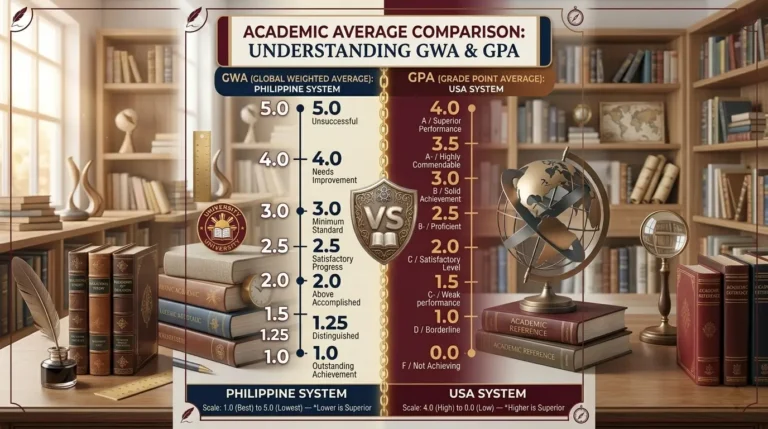
In the Philippine 1.0–5.0 grading scale used by most colleges and universities, a lower GWA number means better academic performance. Here is the general benchmark breakdown used across Philippine Higher Education Institutions (HEIs):
| GWA Range | Performance Level | What It Means |
|---|---|---|
| 1.00 – 1.50 | Outstanding / Excellent | Top of class performance. Summa or Magna Cum Laude range. |
| 1.51 – 1.75 | Very Good | Dean’s List and Cum Laude eligible. Excellent academic standing. |
| 1.76 – 2.00 | Good | Above average. Meets most scholarship GWA requirements. |
| 2.01 – 2.50 | Satisfactory / Average | Good academic standing. Safe from probation at most schools. |
| 2.51 – 3.00 | Fair / Passing | Passing but close to the retention threshold at many schools. |
| Above 3.00 | Failing / Below Standard | Below passing grade. Risk of academic probation or dismissal. |
Remember: In the Philippine GWA system, 1.00 is the HIGHEST grade and 5.00 is FAILING. A lower number always means better performance this is the opposite of the US GPA system where 4.0 is the best.
Not sure where your GWA falls? Calculate your GWA now and find out instantly.
Why “Good” Depends on Your Goal
There is no single answer to what makes a GWA “good” because the benchmark that matters depends entirely on what you are trying to achieve. A GWA of 2.00 is perfectly good for staying enrolled and graduating on time but it falls short of scholarship requirements, Dean’s List eligibility, and Latin Honors. Here is how to read your GWA against each major academic goal:
GWA for Just Passing and Staying Enrolled
At most Philippine colleges and universities that use the standard 1.0–5.0 numerical grading scale, the minimum passing grade per subject is 3.00. Your cumulative GWA must also stay at or below 3.00 to remain in good academic standing. Students whose GWA falls above 3.00 (meaning worse performance) are typically placed on academic probation and risk being dismissed from their program if performance does not improve.
Minimum GWA to stay enrolled at most Philippine universities: 3.00 (equivalent to approximately 75%)
GWA for Scholarship Eligibility
Most government and private scholarship programs in the Philippines set specific GWA requirements as a condition for awarding and maintaining financial assistance. These thresholds are stricter than the basic passing grade because scholarships are intended for academically performing students.
| Scholarship Program | Granting Body | Minimum GWA Required | Notes |
|---|---|---|---|
| DOST-SEI Undergraduate Scholarship | Dept. of Science & Technology | 2.00 or better per semester | Science & Technology courses |
| CHED Tulong Dunong Program | Commission on Higher Education | 2.50 or better | State universities & colleges |
| CHED Merit Scholarship | Commission on Higher Education | 1.75 or better | Competitive academic scholarship |
| SM Foundation College Scholarship | SM Foundation | 2.00 or better | Plus financial need assessment |
| Ayala Foundation Scholarship | Ayala Foundation | 1.75 or better | STEM and business programs |
| OWWA Education Program | Overseas Workers Welfare Admin. | 2.50 or better | OFW dependents |
| GSIS Financial Assistance | Govt. Service Insurance System | 2.50 or better | GSIS member dependents |
| University-based Academic Scholarship | Varies by school | 1.50 – 1.75 | Varies; check with registrar |
A GWA of 2.00 or better is the most common threshold across government scholarship programs in the Philippines. For the most competitive merit-based scholarships, such as the CHED Merit Scholarship and university-based full academic grants, a GWA of 1.75 or better is typically required.
Use our free GWA Calculator to check if your current GWA meets these scholarship requirements.
GWA for Dean’s List Recognition
The Dean’s List (also called Dean’s Lister) is a per-semester academic distinction awarded to students who achieve outstanding performance in a specific term. It is different from Latin Honors, which is awarded at graduation based on your entire college career. A Dean’s List recognition resets every semester you earn it or you don’t, based solely on that term’s GWA.
The standard Dean’s List GWA requirement at most Philippine universities is 1.75 or better per semester, combined with no failing grades and no Incomplete (INC) grades during that semester.
| University | Dean’s List / Honor Roll Tier | GWA Required | Additional Conditions |
|---|---|---|---|
| Most Philippine HEIs (standard) | Dean’s Lister | 1.75 or better | No failing grade, no INC |
| University of the Philippines (UP) | University Scholar | 1.25 or better | No grade below 3.0, min. 15 units |
| University of the Philippines (UP) | College Scholar | 1.45 or better | No grade below 3.0, min. 15 units |
| University of Santo Tomas (UST) | Dean’s Lister | 1.75 or better (86%+) | No subject grade below 2.00 (80%) |
| De La Salle University (DLSU) | Dean’s List | 3.40 GPA or better | No failing grade during the term |
| Ateneo de Manila University | Dean’s List | 3.50 GPA or better | No failing grade during the term |
| Polytechnic Univ. of Philippines (PUP) | President’s / Dean’s Lister | 1.75 or better | Min. 15 units enrolled |
| Pamantasan ng Lungsod ng Maynila (PLM) | First / Second Honor | 1.50 / 1.75 or better | GWA-based ranking system |
Key distinction: UP does not use the term “Dean’s List.” Instead, they award University Scholar (GWA 1.25 or better) and College Scholar (GWA 1.45 or better) distinctions each semester.
GWA for Latin Honors at Graduation
Latin Honors are the highest academic distinctions awarded at graduation in Philippine colleges and universities. Unlike Dean’s List recognition, Latin Honors are based on your cumulative GWA the weighted average of every grade across your entire degree program from first year to final year. Under guidelines from the Commission on Higher Education (CHED), there are three tiers of Latin Honors:
| Honor | Filipino Term | Standard GWA Range (CHED) | GPA Equivalent (approx.) |
|---|---|---|---|
| Summa Cum Laude | With Highest Honors | 1.00 – 1.20 | 3.80 – 4.00 |
| Magna Cum Laude | With High Honors | 1.21 – 1.45 | 3.55 – 3.79 |
| Cum Laude | With Honors | 1.46 – 1.75 | 3.25 – 3.54 |
Track your cumulative GWA every semester using our GWA Calculator to stay on top of your honors eligibility.
Having the right GWA range is necessary, but it is not enough on its own. Most Philippine universities require that Latin Honors candidates also meet all of the following conditions simultaneously:
- No failing grade (5.00 or equivalent) in any subject throughout the entire degree program
- No Incomplete (INC) grade left unresolved past the deadline
- No disciplinary suspension or academic dishonesty record
- Minimum residency requirement at least 75% of total degree units must be completed at the awarding institution
- Minimum academic load per semester UP requires no fewer than 15 units per term unless medically justified
⚠️ Critical: A single failing grade (5.00) in any subject during your entire college career will disqualify you from all Latin Honors at most Philippine universities, if your cumulative GWA is otherwise within the honors range.
GWA for Graduate School Admission in the Philippines
If you are planning to pursue a graduate degree a master’s program (MA, MS, MBA, MPA) or a doctoral program (PhD, EdD) your undergraduate GWA will be one of the first things admissions committees evaluate. While requirements vary by institution, the general benchmarks across Philippine graduate schools are:
| Graduate Program Level | Typical Minimum GWA for Admission | Notes |
|---|---|---|
| Master’s Degree (MA, MS, MBA) | 2.00 or better | Most state universities and private HEIs |
| Master’s Degree (competitive programs) | 1.75 or better | UP, Ateneo, DLSU graduate schools |
| Doctoral Program (PhD, EdD) | 1.75 or better in graduate coursework | Usually requires Master’s GWA, not undergraduate |
| Professional School (Law, Medicine) | Varies; often 2.00 or better | Plus entrance exam scores |
GWA for Job Applications and Employment
In the Philippine job market, GWA is most relevant for fresh graduates applying for their first professional role. Many large corporations, government agencies, and competitive employer programs set minimum GWA requirements as a screening criterion for new hires.
| Employer Type | Common GWA Requirement | Notes |
|---|---|---|
| Government agencies (CSC-governed) | No official GWA cutoff | Merit and fitness-based; exams required |
| Large private corporations (entry-level) | 2.00 – 2.50 or better | Used as initial screening filter |
| Banking and finance (management trainee) | 1.75 or better | Often combined with aptitude tests |
| Top multinational companies (graduate programs) | 1.75 or better | Very competitive pools |
| Government-owned corporations (GOCCs) | 2.00 or better | Board exam results often matter more |
| Teaching/academic positions | 1.75 or better | LET passing + GWA requirement |
As you gain work experience, your GWA becomes less important to employers. Most hiring managers give more weight to GWA only for candidates with fewer than two years of professional experience. After that point, your performance record, skills, and portfolio carry significantly more weight than your college grades.
What is a Good GWA by University in the Philippines?
Because Philippine universities use different grading scales and have different academic cultures, what counts as a “good” GWA needs to be interpreted in the context of your specific school. Here is a practical reference for the most commonly attended universities:
| University | Grading Scale | Good GWA | Dean’s List GWA | Cum Laude GWA |
|---|---|---|---|---|
| UP Diliman / Manila / Los Baños | 1.0 – 5.0 | 1.75 or better | 1.45 (College Scholar) | 1.75 or better |
| University of Santo Tomas (UST) | 1.0 – 5.0 | 1.75 or better | 1.75 (86%+) | 1.75 or better |
| Polytechnic Univ. of Philippines (PUP) | 1.0 – 5.0 | 1.75 or better | 1.75 or better | 1.75 or better |
| De La Salle University (DLSU) | 0.0 – 4.0 (ascending) | 3.00 GPA or better | 3.40 GPA | 3.40 GPA (equiv.) |
| Ateneo de Manila University | Letter / GPA (ascending) | B+ (3.5 GPA) or better | 3.50 GPA | 3.40 GPA (equiv.) |
| Far Eastern University (FEU) | 0.0 – 4.0 (ascending) | 3.00 GPA or better | 3.00+ GPA | 3.00+ GPA (equiv.) |
| Mapúa University | 1.0 – 5.0 | 1.75 or better | 1.75 or better | 1.75 or better |
| Most State Universities (SUCs) | 1.0 – 5.0 | 2.00 or better | 1.75 or better | 1.75 or better |
Note for DLSU, Ateneo, and FEU students: These schools use an ascending GPA scale (higher number = better grade), which is the opposite of the standard Philippine 1.0–5.0 system. A GPA of 3.40 at DLSU is roughly equivalent to a 1.60 GWA on the standard Philippine scale.
GWA Benchmarks at a Glance
Here is a consolidated reference that summarizes what each GWA range means across the most important academic and professional contexts for Filipino students:
| GWA | Percentage Equiv. | Academic Level | Dean’s List? | Scholarship? | Latin Honors? |
|---|---|---|---|---|---|
| 1.00 | 96–100% | Excellent (Summa range) | ✔ Yes | ✔ Yes | ✔ Summa Cum Laude |
| 1.25 | 94–96% | Excellent (Magna range) | ✔ Yes | ✔ Yes | ✔ Magna Cum Laude |
| 1.50 | 91–94% | Very Good (Magna range) | ✔ Yes | ✔ Yes | ✔ Magna Cum Laude |
| 1.75 | 89–91% | Good (Cum Laude boundary) | ✔ Yes | ✔ Yes | ✔ Cum Laude |
| 2.00 | 86–89% | Very Satisfactory | ✘ Usually not | ✔ DOST, CHED | ✘ No |
| 2.25 | 83–86% | High Average | ✘ No | ⚠ Some programs | ✘ No |
| 2.50 | 80–83% | Average | ✘ No | ⚠ Limited | ✘ No |
| 2.75 | 77–80% | Fair / Passing | ✘ No | ✘ No | ✘ No |
| 3.00 | 75–77% | Minimum Passing | ✘ No | ✘ No | ✘ No |
| Above 3.00 | Below 75% | Failing | ✘ No | ✘ No | ✘ No |
How to Know If Your GWA Is Good Enough
Rather than comparing your GWA to a general standard, the most useful question is: good enough for what? Here is a simple checklist to evaluate your GWA against your specific goals:
If your goal is to stay enrolled and graduate
- Minimum needed: GWA of 3.00 or better (on the 1.0–5.0 scale)
- Check: Your GWA per subject AND your cumulative GWA each semester
- Risk signal: Any subject grade above 3.00 puts you at risk of failing that course
If your goal is to qualify for a government scholarship
- Minimum needed: GWA of 2.00 or better (DOST-SEI, SM Foundation)
- For CHED merit: GWA of 1.75 or better
- Important: Most scholarships evaluate your SEMESTRAL GWA, not just cumulative
If your goal is to make the Dean’s List
- Minimum needed: GWA of 1.75 or better this semester, with no failing or INC grades
- UP students need: 1.45 for College Scholar, 1.25 for University Scholar
- UST students need: 1.75 with no subject grade below 2.00
If your goal is to graduate with Latin Honors
- Cum Laude: Cumulative GWA of 1.46–1.75, no failing grade in any subject
- Magna Cum Laude: Cumulative GWA of 1.21–1.45, no failing grade in any subject
- Summa Cum Laude: Cumulative GWA of 1.00–1.20, no failing grade in any subject
- Critical: GWA alone is not enough residency, disciplinary standing, and load requirements must all be met
If your goal is to apply for a job as a fresh graduate
- Competitive: GWA of 1.75 or better for top multinational or banking roles
- Acceptable: GWA of 2.00–2.50 for most standard entry-level corporate positions
- Note: Many employers use GWA only as an initial screening filter your interview performance, skills, and internship experience matter equally
What is a Good GWA for Senior High School (SHS) Students?
Senior High School (SHS) students in the Philippines are graded under the Department of Education (DepEd) K–12 grading system, which uses a 0–100 numerical percentage scale not the 1.0–5.0 GWA scale used in college. For SHS students, “GWA” typically refers to the General Average computed by averaging quarterly grades across all subjects each semester.
| SHS General Average (DepEd Scale) | Grade Descriptor | Academic Standing |
|---|---|---|
| 90 – 100 | Outstanding (O) | Excellent — With Highest Honors / With Honors |
| 85 – 89 | Very Satisfactory (VS) | Very Good — With High Honors |
| 80 – 84 | Satisfactory (S) | Good — With Honors |
| 75 – 79 | Fairly Satisfactory (FS) | Passing |
| Below 75 | Did Not Meet Expectations (DNM) | Failing — Remedial class required |
For SHS students applying for college admission, a general average of 85 and above is typically considered competitive for state universities (SUCs) and private HEIs. The University of the Philippines (UP) College Admission Test (UPCAT) and Ateneo College Entrance Test (ACET) also consider your SHS general average as part of the admission evaluation.
What If Your GWA Is Lower Than You Need?
A GWA that falls short of your target is fixable especially early in your college years. Because GWA is a weighted average across all semesters, strong performance in future terms can meaningfully raise your cumulative average over time. Here are the most practical strategies:
1. Focus on High-Unit Subjects First
Because GWA is weighted by credit units, subjects with more units have a greater impact on your overall average. A 4-unit major subject affects your GWA twice as much as a 2-unit minor course. Prioritize study time and effort on your highest unit subjects to maximize the GWA improvement from each semester.
2. Avoid Failing and Incomplete Grades
A failing grade (5.00) not only damages your GWA it permanently disqualifies you from Latin Honors at most Philippine universities, regardless of how strong your future performance is. If you are struggling in a subject, consult your professor early, attend tutorials, and explore remedial options before the semester ends. If you must withdraw from a subject, do so officially (DRP) rather than accumulating an Incomplete (INC) or failing mark.
3. Understand Your Cumulative GWA Math
Use our GWA calculator to run scenarios. If your current cumulative GWA is 2.00 and you want to reach 1.75, calculate exactly what GWA you need in your remaining semesters to hit that target. The more semesters you have remaining, the more achievable the improvement becomes because you have more units to weight toward your target average.
4. Balance Your Semester Load
Stacking all your most difficult major subjects in a single semester is one of the fastest ways to damage your GWA. If your program allows flexibility in scheduling, spread heavy subjects across semesters and balance them with lighter electives. A stable, consistently good GWA across multiple semesters is easier to build than attempting an extreme recovery after a weak term.
5. Resolve All INC Grades Immediately
An Incomplete (INC) grade that is not resolved before the university deadline automatically converts to a grade of 5.00 (Failing) at most Philippine universities. A 5.00 is both a GWA disaster and a permanent Latin Honors disqualifier. Treat any INC grade as an urgent academic emergency, not a grade you can deal with later.
Ready to check your GWA right now? Use our free online GWA Calculator enter your subjects, units, and grades and get your result in seconds.